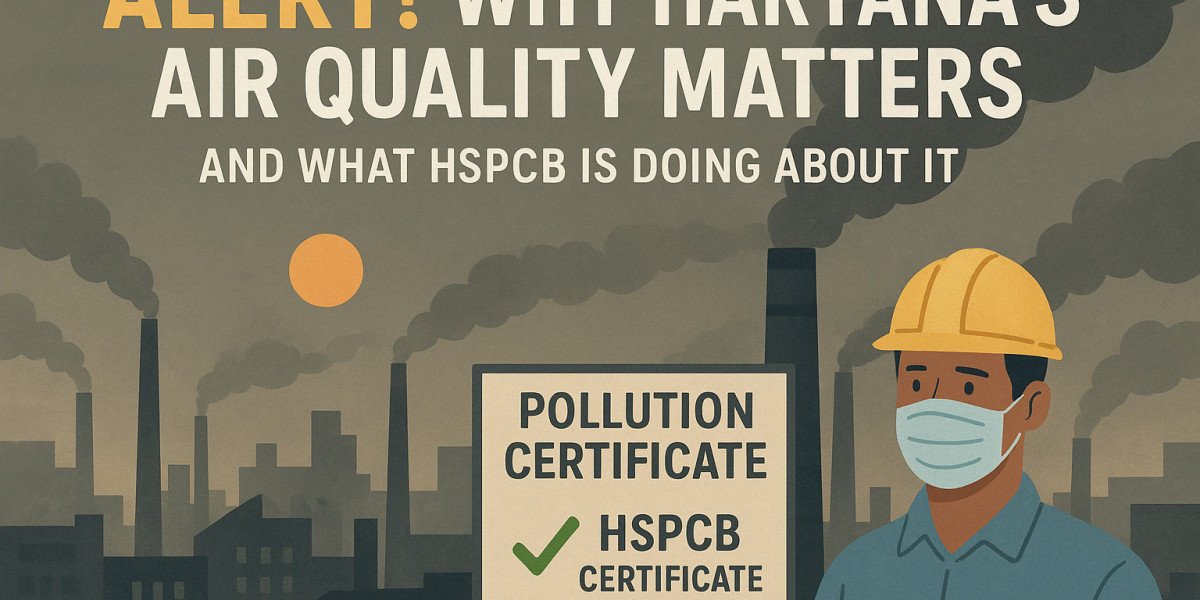

Haryana is one of the fastest-growing industrial areas in India, which has contributed to the growth of numerous manufacturing units, infrastructure projects, and urban areas. However, the rapid expansion of the area has affected the air quality in the region. The cities of Gurugram, Faridabad, and Panipat often rank among the areas with the most polluted air in India, especially in the winter season. Therefore, it is essential for industries, citizens, and policymakers to know the reasons why air quality in Haryana is crucial and what steps the Haryana State Pollution Control Board (HSPCB) is taking in this respect.
This article unravels the air pollution issues in Haryana, the associated health risks and money loss, and the important work done by the HSPCB mainly through the HSPCB consent, pollution certificate for factory, and HSPCB certificate process-related mechanisms.
Why Haryana's Air Quality Is Becoming a Big Problem
1. A Growing Industrial Corridor
Haryana is an area with a large industrial belt made up of the following towns: Gurugram, Faridabad, Sonipat, Panipat, and Hisar. The industrial belts comprise textile, chemical, auto parts, metal, and food-processing industries. On the one hand, they are significant contributors to the GDP, and on the other hand, they are the major emitters of pollutants like SO₂, NOx, particulate matter, and volatile organic compounds.
2. Vehicular Congestion
The border cities of the NCR are the places where thousands of inter-state vehicles pass daily. The emission from the diesel trucks along with traffic jams is a great contributor to PM2.5 and PM10 levels.
3. Crop Burning in Neighboring States
In the months of October and November, the pollution caused by the burning of stubble in Punjab and Haryana is so severe that the AQI for the entire area reaches the "Severe" category.
4. Construction Dust
Real estate development and infrastructure projects are the main sources of the production of a large quantity of dust, which very often becomes the major cause of air pollution in that particular area.
Health Impact: Why You Should Care Today
Air pollution should only be considered an environmental problem since it has a direct negative effect on health and productivity. A number of studies have disclosed that exposure to contaminated air for a long time could risk of the following:
Chronic respiratory diseases such as asthma, COPD, and bronchitis
Cardiovascular diseases and stroke
Weakened immune system
Irritated eyes and skin problems
Reduced lung capacity in children
Working people of Haryana, who work outdoors, and children going to school are the most vulnerable groups to such risks. Therefore, pollution control is not only a regulatory action but also a public health intervention.
How HSPCB Is Responding to Haryana’s Air Quality Crisis
The Haryana State Pollution Control Board (HSPCB) is a department that is in charge of the followings in the state: monitoring, regulating, and controlling industrial and environmental pollution. To lower the pollution level, the Board is implementing the following measures:
1. Mandatory HSPCB Consent for Industries
Every industrial unit in Haryana is obliged to obtain HSPCB consent prior to the start of operations. The consents are of two kinds:
Consent to Establish (CTE) – prior to building or installing
Consent to Operate (CTO) – prior to actual working operations
The consents issued are based on the Water Act, Air Act, and Environment Protection Act to ensure that industries are following emission norms and that they are taking sufficient pollution control measures.
Non-authorized consent may lead to:
Heavy fines
Closure letters
Slowdown of extension projects due to lack of approval
Thus, the HSPCB consent procedure is the first weapon in the war against industrial pollution.
2. Issuing Pollution Certificate for Factory
Industries need to have a pollution certificate for factories to prove that they are compliant with the environmental standards. This certificate is a guarantee that:
The factory has set up adequate pollution control equipment
The emissions are within allowed limits
The factory produces and handles hazardous waste properly
Groundwater and surface water are well-protected
The pollution certificate is not only a regulatory requirement but also a hallmark of responsible industrial operation.
3. Monitoring, Real-Time Data & Strict Compliance
The HSPCB has implemented a network of continuous ambient air quality monitoring stations scattered throughout the area to keep track of particulate matter, gases, and industrial emissions releases. The monitoring stations record the release of:
particles
gases
industrial emissions
The most polluting industries should install online continuous emission monitoring systems (CEMS) that should be directly linked to HSPCB servers. This enables the Board to act promptly when there are violations.
4. Crackdown on High-Polluting Units
HSPCB regularly inspects industrial districts and issues:
Orders for closure (shutdown commands) directed at non-compliant units
Notices demanding an explanation (show-cause letters)
Fines related to the environment
The Board does this to ensure that enterprises take their certificate obligations seriously.
5. Removing Construction Dust & Solid Waste
In order to lessen the dust pollution, HSPCB obliges the following:
Initiatives to cover construction sites
Anti-smog guns for large projects
Regular watering
Debris disposal regulations
Furthermore, the adoption of waste segregation and the ban on open burning facilitate the local pollution reduction.
6. Awareness Drives And Public Participation
HSPCB cooperates with schools, RWAs, NGOs, and industries to conduct various public awareness methods such as:
Implementing Clean Air campaigns
Conducting Tree plantation events
Environmental compliance workshops
The involvement of the public is the only way air quality in Haryana can be improved.
Why Air Quality in Haryana Matters to Everyone
Regardless of the fact that you might be a citizen, a business owner, or an industry operator—air quality impacts every single one of life's aspects:
Health: Clean air is a direct route to better health
Economy: Air of better quality results in higher productivity
Real Estate: Cities with good air quality become attractive to investors
Sustainability: Industries that comply enjoy positive reputation and trust
That is why taking HSPCB consent, adhering to standards, and getting the pollution certificate for the factory are so important.
Conclusion
Clean air is the foundation of a high quality of life and a prosperous economy. We all have a shared responsibility to protect air quality in Haryana.