
Understanding how software products come into existence is instrumental in making smart development decisions. Whether it be building a basic app for $20,000–$40,000, a mid-level solution for $50,000–$120,000, or an advanced enterprise platform, often upwards of more than $150,000, SDLC shapes everything from the beginning-actual planning and design, to the very end-testing and deployment. These cost ranges remain very accurate for 2025 and reflect differences in complexity, integrations, and team structure.
In this blog, we'll discuss the most common SDLC approaches every team should be aware of, explain how each of them works in detail, and provide some example use cases. For businesses seeking reliable software maintenance services, choosing the right SDLC approach is of great significance for long-term stability and scalability.
The Success Blueprint: Waterfall Model
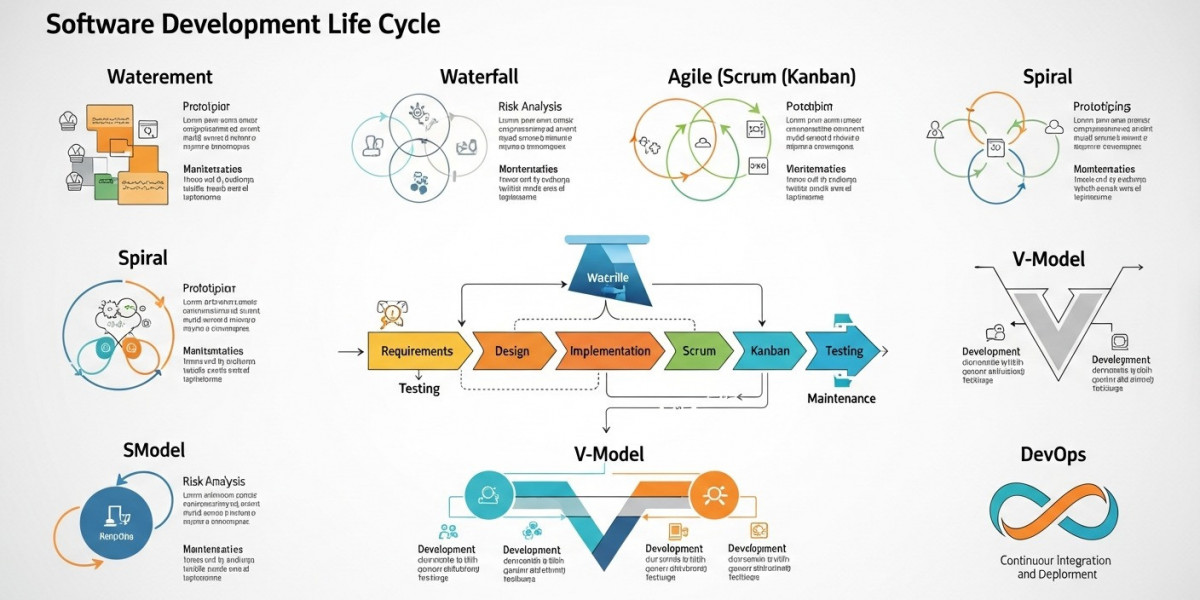
The classic SDLC model is the Waterfall approach. The Waterfall emphasizes requirements, design, development, testing, deployment, and maintenance sequentially. Because each phase of the Waterfall must be completed before moving on to the next, it remains a popular choice for industries with strict regulations or for clearly defined project needs.
Teams often go with the Waterfall when the scope won't change. For instance, government systems or medical software all use this method because the documentation is thorough, and the process is predictable. Although much less flexible than modern models, the structure of Waterfall reduces ambiguity and aids teams in maintaining rigorous control.
Inspiring Iterations: Agile Methodology
Agile has become the premier choice for quick-moving teams that require adaptability. Instead of long cycles, Agile subdivides the process into repetitive sprints, usually lasting two to four weeks. Each sprint encompasses planning, development, testing, and review, allowing frequent updates and early delivery.
This is an appropriate methodology that works best for startups and products in their evolution stage, since the vision will keep on growing once users start providing feedback. A real-world example includes mobile app companies that normally roll out updates every few weeks. Agile keeps developers and stakeholders aligned while ensuring continuous improvement.
Scrum Framework: Sprinting Ahead
Scrum is an Agile framework that brings structure to the iterative development cycle. It introduces defined roles: Product Owner, Scrum Master, and Development Team. Daily standups, sprint reviews, and retrospectives create a rhythm that holds everyone accountable.
Teams opt for Scrum when they require transparency and collaboration. For instance, a fast-paced ecommerce company that releases new features every week stands to gain much from the speedy flow that Scrum applies. Because Scrum fosters fast progress and iteration at all times, it's one of the most widely adopted systems across technology teams.
Continuous Innovation: DevOps Model
DevOps integrates development operations into a single workflow: the deployment is not viewed as a milestone that happens at the very end, but rather as part of the continuous integration and continuous delivery. At its core sits automation: every release of new code is tested, reviewed, and goes live with as little human interaction as possible.
Large-scale applications, such as video streaming services or cloud solutions, rely on DevOps to avoid downtime and performance bottlenecks. With DevOps, friction goes down and speed increases across the entire release cycle. It is ideal for products that need constant updates.
Flexibility at Its Best: Iterative Model
The Iterative Model starts with the development of a crude product and then enhances it through iterations. Contrasting with Agile, which is powered by sprints and collaboration rituals, iteration focuses only on refining a working model through evaluation and feedback.
Teams use this approach when they have to validate an idea early. For example, a company creating a fitness app may release a minimal version to test user engagement. After analyzing real feedback, the developers refine the features, UI, and expand capabilities in a second cycle, and so on.
Planning with Accuracy: Spiral Model
The Spiral Model incorporates elements of iterative development with risk management. Projects go through spirals, each of which involves planning, risk analysis, engineering, and evaluation. This model is best utilized for large systems, projects involving a high degree of risk, or those that are complex and require close monitoring.
A good use case for this would be a financial software system that deals with sensitive data. The Spiral Model allows the team to find risks early, test theories, and build up to the final product incrementally without surprises. Although more expensive, the precision it brings provides safety like no other.
Early Value Delivery: V-Model (Verification & Validation)
It enhances Waterfall by incorporating testing into each stage of the V-Model. Testing activities, instead of waiting until the end, run parallel to development phases. Example system design with system testing and architecture design with integration testing.
Teams select the V-Model when quality absolutely cannot be compromised. Industries that especially appreciate its emphasis on validation include aviation, automotive safety, and healthcare. With fewer last-minute bugs and structured testing, the V-Model offers reliability where it matters most.
Evolving with Users: Prototype Model
The Prototype Model serves best when teams seek clarity or when stakeholders are not sure about the requirements. Developers create a mock-up or a simplified version of the final product. Early visualization helps in refining requirements and improves communication.
Imagine the development of a hotel booking mobile application. A prototype shown to the stakeholders, highlighting how search, filtering, and booking flow will look and work, saves the developers from receiving so much valuable feedback until they actually begin writing full code. It would reduce misunderstandings and speed up full-scale development.
Clarity through Collaboration: RAD - Rapid Application Development
With RAD, development time is shortened since the primary focus is on rapid prototyping and fast feedback cycles. It involves active involvement with users and tight collaboration through the entire life cycle. Teams are to build modules, do quick tests to refine them until they match expectations.
This methodology is best suited for organizations in which speed is of the essence but not at the cost of quality. Quite naturally, a startup building an MVP or Minimum Viable Product benefits from RAD because it strikes a balance between speed and user-focused refinement.
10. Scaling with Confidence: Big Bang Model
Although rarely used in large systems, the Big Bang Model applies to experimental or small-scale projects. The development begins with little planning, which develops as ideas fall into place. It is creative, suitable for teams that are trying to explore new concepts or test the workability of some theory.
The Big Bang model, however, requires flexible stakeholders and an open budget, as results can range all over the place. It's not ideal for mission-critical solutions, but for innovation labs and R&D teams, Big Bang opens the door to unstructured creativity.
Continuous Improvement: Hybrid and Tailored SDLC Models
The modern team usually mixes and matches different SDLC models to best suit their needs. For instance, a company might make use of Waterfall for planning, Agile for development, and DevOps for deployment. Thus, the hybrid approach provides structure, yet without sacrificing flexibility. Business environments change rapidly, and customized blends support teams through dynamically changing priorities. Be it a B2B SaaS platform or a consumer-facing mobile app, the hybrid SDLC models strike a balance with immense power.
Final Thought:
Creating Better Software One Method at a Time: Choosing the right SDLC method shapes not only how your product is built but also how it evolves. Understanding your team's workflow, requirements, and long-term vision is the key. While each has its strengths, the best is that which supports scalability, collaboration, and predictable growth. Of prime importance in these considerations is to choose the most suitable software development life cycle model for your product to remain adaptable and future-ready.