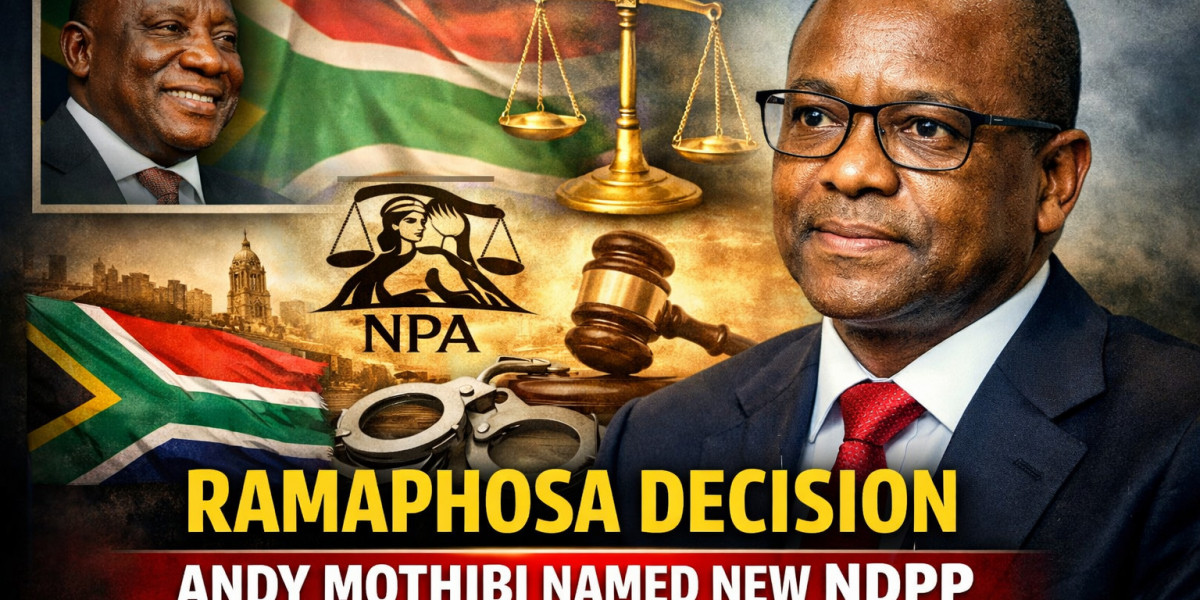

The NDPP sits at the heart of South Africa’s criminal justice system. Tasked with leading the National Prosecuting Authority (NPA), the office holds the power to decide which cases proceed to court and which do not. Over the past decade, the NPA has struggled with credibility challenges, leadership instability, and accusations of political interference. Against this backdrop, Ramaphosa’s decision has reignited debate about whether South Africa is finally turning a corner or merely reshuffling leadership without addressing structural weaknesses.
Advocate Andy Mothibi is no stranger to high-stakes accountability work. With a background rooted in complex investigations and institutional reform, his elevation comes at a time when public trust in state institutions remains fragile. Supporters argue that Mothibi’s experience equips him to strengthen prosecutorial processes, fast-track corruption cases, and restore confidence in the NPA. Critics, however, caution that the real test will lie not in credentials but in outcomes—particularly whether powerful individuals implicated in state capture and large-scale corruption will face decisive legal action.
President Ramaphosa has repeatedly framed his administration as one committed to ethical governance and constitutional integrity. The NDPP appointment aligns with this narrative, especially as the country continues to grapple with the legacy of the Zondo Commission. That inquiry laid bare systemic corruption and recommended criminal prosecutions against individuals across both the public and private sectors. Many of those recommendations remain untested in court, making the NDPP’s leadership pivotal in translating findings into justice.
Public reaction to the appointment has been mixed. Civil society organizations have welcomed the move cautiously, emphasizing the need for transparency, independence, and urgency. Legal analysts note that South Africa does not suffer from a lack of laws, but rather from inconsistent enforcement. In this sense, Mothibi’s role will be judged by his willingness to act without fear or favor, even when cases involve politically connected figures.
Beyond South Africa’s borders, the decision is also being observed across Africa. The strength of prosecutorial institutions is increasingly seen as a benchmark for democratic maturity on the continent. Countries battling corruption often point to South Africa as a legal reference point, given its robust constitution and independent judiciary. A credible, effective NDPP can therefore enhance South Africa’s standing as a regional leader in governance and accountability.
At the same time, expectations are high and patience is thin. Ordinary South Africans continue to face economic hardship, service delivery failures, and declining trust in political leadership. For many citizens, justice reform is not an abstract principle but a daily necessity tied to safety, opportunity, and dignity. High-profile prosecutions, especially in corruption and organized crime cases, are seen as essential signals that the state is reclaiming its authority.
The appointment also intersects with internal political dynamics within the African National Congress (ANC). As the party prepares for key milestones in 2026, governance decisions are increasingly scrutinized through both legal and political lenses. The NDPP’s independence will be crucial in dispelling perceptions that prosecutorial decisions are influenced by factional interests or electoral calculations.
Ultimately, Ramaphosa’s decision to elevate Andy Mothibi to the NDPP role represents more than a personnel change. It is a statement about the direction of South Africa’s justice system and the seriousness of its anti-corruption agenda. Whether this moment becomes a turning point or a missed opportunity will depend on concrete actions in the months ahead—cases pursued, convictions secured, and public confidence restored.
As South Africa navigates this critical chapter, media platforms committed to accountability journalism will continue to monitor developments closely, amplify diverse perspectives, and hold power to account. In doing so, they play a vital role in ensuring that justice reform remains not just a promise, but a lived reality for all citizens—true to the mission of Africa Heritage Voice.