
Introduction
Why Rivet Selection Matters More Than You Think
Rivets may appear simple, but the wrong choice can compromise joint strength, sealing, vibration resistance, and product lifespan. When you compare a trifold rivet with a leakproof rivet, the difference goes far beyond shape or installation. Each serves a distinct purpose and performs differently under load, vibration, and environmental exposure.
This article explains the real, functional differences between trifold rivets vs. leakproof rivets. You will learn how each rivet works, where it performs best, and when one is more suitable than the other. The goal is to help you make confident, application-driven fastening decisions backed by engineering logic and real-world case studies.
Understanding Rivets in Modern Manufacturing
Rivets are permanent mechanical fasteners used to join materials when welding or threading is impractical. They offer speed, consistency, and vibration resistance.
Why Specialized Rivets Exist
Standard rivets cannot solve every fastening challenge. Some joints require:
Load distribution
Gap filling
Fluid sealing
Vibration resistance
This is where specialized options like trifold rivets and leakproof rivets become essential.
What Is a Trifold Rivet?
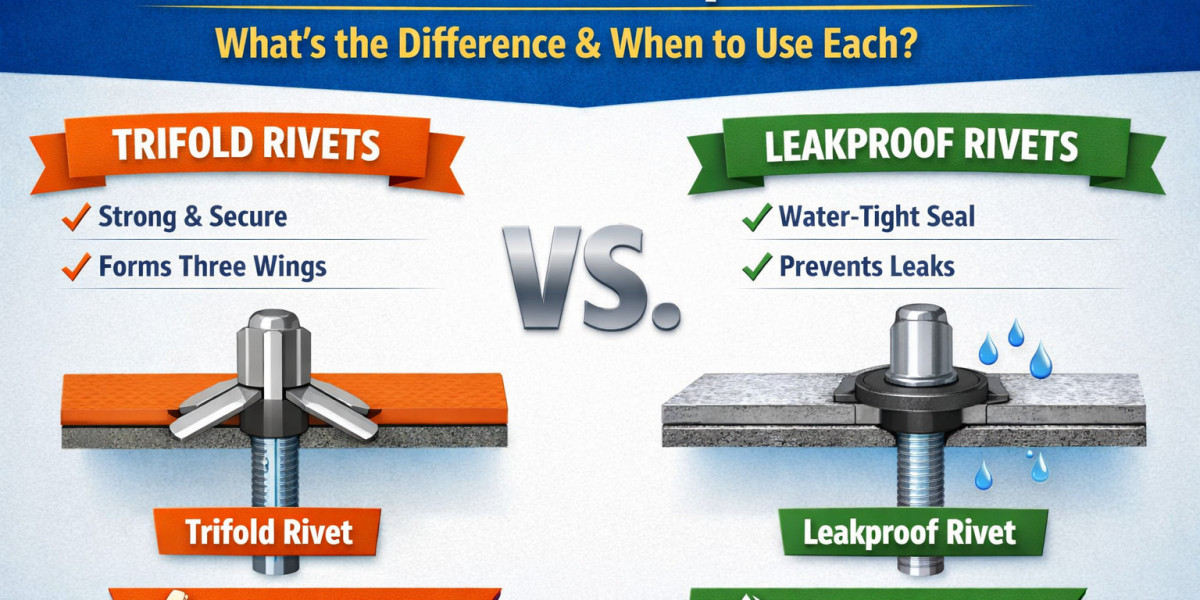
A trifold rivet is a type of blind rivet designed to split into three legs on the blind side during installation.
How a Trifold Rivet Works
When installed, the rivet body expands and folds into three distinct legs. This creates a wide bearing area behind the application.
Key Characteristics of a Trifold Rivet
Excellent load distribution
Strong grip in thin or soft materials
Reduced pull-through risk
Good vibration resistance
A trifold rivet is often chosen when material integrity is a concern.
What Is a Leakproof Rivet?
A leakproof rivet, also known as a sealed rivet, is designed to prevent the passage of liquids, gases, or air through the rivet body.
How a Leakproof Rivet Works
The mandrel is retained or sealed inside the rivet body. This blocks any path for fluid migration.
Key Characteristics of a Leakproof Rivet
Airtight and watertight sealing
Improved corrosion resistance
Cleaner joint finish
Better protection for enclosed components
A leakproof rivet is selected when sealing performance is critical.
Trifold Rivet vs. Leakproof Rivet: Core Design Differences
Expansion Behavior
Trifold rivet: Expands into three legs for load spreading
Leakproof rivet: Expands conventionally but seals the mandrel path
Primary Function
Trifold rivet: Structural support in weak materials
Leakproof rivet: Sealing against fluids and air
Joint Outcome
Trifold rivet: Strong mechanical anchoring
Leakproof rivet: Secure, sealed joint
Understanding these differences is essential when comparing trifold rivets vs. leakproof rivets.
Strength and Load Performance Comparison
Trifold Rivet Strength Behavior
The tri-leg expansion distributes load over a larger area. This reduces stress concentration and material deformation.
Leakproof Rivet Strength Behavior
A leakproof rivet focuses more on joint integrity and sealing than on load distribution.
If your priority is mechanical support in thin materials, a trifold rivet often performs better.
Sealing Performance: Where Leakproof Rivets Excel
Why Sealing Matters
Unsealed joints can allow:
Moisture ingress
Air leakage
Dust contamination
Corrosion initiation
A sealed rivet prevents these risks by design.
Trifold Rivet Limitations in Sealing
While a trifold rivet offers a strong mechanical grip, it does not fully seal the mandrel hole unless specifically engineered for sealing.
Vibration and Fatigue Resistance
Trifold Rivet Behavior Under Vibration
The expanded legs grip firmly, reducing loosening in vibration-prone environments.
Leakproof Rivet Behavior Under Vibration
Leakproof rivets maintain joint integrity and sealing but may not distribute load as widely as trifold designs.
When vibration is high and sealing is secondary, a trifold rivet may be preferable.
Material Compatibility Considerations
Both rivet types are available in multiple materials.
Why Material Choice Matters
Prevents galvanic corrosion
Maintains joint strength
Supports environmental durability
Selecting compatible materials is as important as choosing between a trifold rivet and a leakproof rivet.
Case Study 1: Trifold Rivet Solving Material Pull-Through
The Challenge
A manufacturer faced repeated pull-through failures when fastening thin sheet materials using standard blind rivets.
The Solution
Switching to a trifold rivet increased the bearing area on the blind side.
The Result
Improved joint strength
Reduced rework
Longer service life
This case highlights how trifold rivets solve structural issues without increasing material thickness.
Case Study 2: Leakproof Rivet Preventing Fluid Ingress
The Challenge
An enclosed assembly experienced internal corrosion due to moisture entering through fastener points.
The Solution
Replacing standard rivets with a leakproof rivet eliminated the leakage path.
The Result
Zero fluid ingress
Improved corrosion resistance
Enhanced product reliability
This case demonstrates why a sealed rivet is essential for enclosed or sensitive assemblies.
Trifold Rivets vs. Leakproof Rivets: When to Use Each
Choose a Trifold Rivet When:
Materials are thin or soft
Load distribution is critical
Pull-through risk exists
Vibration resistance is required
Choose a Leakproof Rivet When:
Sealing is essential
Moisture or air ingress is a risk
Internal components need protection
Corrosion prevention is critical
Understanding these conditions simplifies the decision between trifold rivets vs. leakproof rivets.
Common Mistakes When Selecting Rivets
Choosing based on price alone
Ignoring sealing requirements
Overlooking material thickness
Assuming all blind rivets perform the same
Avoiding these mistakes improves joint reliability and product lifespan.
Why Rivet Engineering Support Matters
Rivets may be small, but their impact is significant. Working with experienced manufacturers helps ensure:
Correct rivet selection
Consistent quality
Reliable performance
Avlock International India Pvt. Ltd focuses on engineered fastening solutions designed to meet real-world demands across industries.
Conclusion
The difference between a trifold rivet and a leakproof rivet lies in purpose, not preference. One prioritizes load distribution and grip, while the other ensures sealing and protection. When you understand joint requirements, material behavior, and environmental exposure, choosing between trifold rivets vs. leakproof rivets becomes straightforward.